Week 3—Monday
Documentation and Downloads
Week 3 of the year continues the concerted (if somewhat piecemeal) process of project spring cleaning. Shipping the Qt version of OpoLua remains a priority and I spent much of the day on release adjacent tasks. I also found my thoughts turning to grand ideas of finally packaging things like Reporter, changes, and InContext, but I must resist! (For the time being, at least.) That said, I did take a little time out to work on the endless task that is home infrastructure.
OpoLua
Last week, before getting distracted by packaging all the things, I identified a few remaining tasks for shipping OpoLua, our modern OPL runtime:
- download links
- screenshots
- documentation
- consolidate shared resources in the source tree
Of these, the highest priorities seemed to be ‘download links’, and ‘documentation’. Both of these will help users install the app: links to downloadable packages; and , for Linux, instructions for how to add our (as yet non-existent) package repositories.
Download Links
The OpoLua website is a Jekyll static site that lives the docs folder of the source tree, and is built as part of our GitHub Actions build workflow. This makes it really easy to inject details like the current version number into the site build and, armed with the jekyll-environment-variables plugin, it was easy to update the template to add a link to the latest GitHub release:
<p class="download-links">

    <a href="https://apps.apple.com/app/opolua/id1604029880">
      <img src="images/Download_on_the_App_Store_Badge_US-UK_RGB_blk_092917.svg" />
    </a>

    <br/>

    <a href="https://github.com/inseven/opolua/releases/tag/{{ site.env.VERSION_NUMBER }}">
      Download for macOS, Windows, and Linux
    </a>

</p>
While I’d like to increase the prominence of these new platforms (the App Store link dominates somewhat), something is better than nothing, and I’m pretty pleased with the result:

Documentation
As OpoLua has grown to target multiple platforms, support different OPL versions, and include a suite of CLI utilities, it’s become clear that short FAQ we created when we first shipped was insufficient. Keen to make room for growth, I added a documentation section, styled after Just The Docs:

Our documentation is sparse but now there’s somewhere to put it
To complement these structural changes, I also added highlight.js, Mermaid, and jekyll-gfm-admonitions, to provide us with conveniences for syntax highlighting, diagramming, and GitHub-style admonitions respectively.
Home Infrastructure
Over the past few days, I’ve been slowly pushing on with my home infrastructure setup. I finally resigned myself to using Ansible for managing my NAS/server—hopefully this will make it easier to keep the configuration in source control and increase my confidence as I continue to move away from Big Tech hosted services.
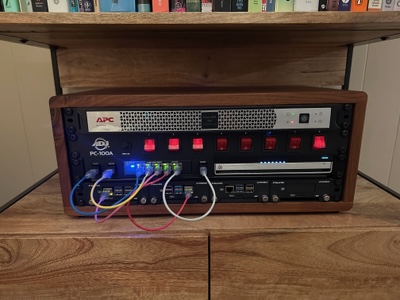
I also took delivery of a new 1U rack shelf and spent a little while moving my LincStation N2 NAS/server into the rack, indulging in the prerequisite CAD and 3D printing to mount the network switch alongside it: